To the Ministry of Health Malaysia,
I am writing as a Malaysian, a former smoker and a long-term vaper who has watched vaping change in this country for nearly two decades. I am not asking KKM to call vaping safe. I am asking KKM to distinguish adult nicotine use, underage access, disposable products, drug-laced cartridges and the illicit market, then regulate each problem according to evidence and risk.
Good policy should not choose a target simply because it is easiest to find. It should choose a target because the evidence shows that is where the actual harm is occurring.
Today, lawful products can face an official RM5,000 registration fee for every product type or variant before laboratory costs; bottled e-liquid is limited to 15 ml; and online sales are prohibited even though modern identity verification can create an auditable transaction trail. At the same time, the most serious public concerns repeatedly raised involve underage access, cheap disposable products and cartridges adulterated with drugs.
This is the central question of this letter: are we regulating the real risks, or simply imposing the easiest restrictions on the users and businesses that are easiest to find?
Children must be protected. Sellers to minors should be punished. Drug cartridges should be dismantled at the source. But adult former smokers, compliant vapers and lawful businesses should not be treated as though they are the same problem.
Contact KKM Through Channels That Create a Record
If you agree that children should be protected without punishing every adult user, state your view through KKM’s official channels. Keep it short, specific and respectful. For a formal enquiry or complaint, ask for a reference number and a written response.
Act 852 & Product Registration
For enquiries on Act 852 implementation, registration and product regulation.
Official KKM source ↗Office of the Health Minister
Official ministerial office channels for policy feedback and requests for a response.
Official KKM directory ↗Formal KKM Record
Use SISPAA if you want your feedback or complaint recorded through the government’s formal system.
Official KKM portal ↗One personalised, clear message that can be answered is more useful than repeated automated messages. State your own experience or concern and keep it professional.

Different Problems Cannot Be Reduced to One Word
An adult smoker switching away from cigarettes is not the same as a schoolchild buying a disposable. Commercial nicotine e-liquid is not the same as an illicit THC cartridge. A licensed retailer is not the same as a criminal network filling cartridges with synthetic drugs.
Vape.
When everything is described with the same word, the details that actually determine risk disappear: who used it, what substance was used, where the product came from and whether a law was already broken.
Public-health communication should clarify those differences, not erase them.
For Adult Smokers, the Relevant Comparison Is Vaping Versus Smoking
For someone who does not smoke, the best choice is not to start using nicotine. But for an existing smoker, the relevant policy comparison is not vaping versus perfectly clean air. It is switching away from combustion versus continuing to inhale cigarette smoke.
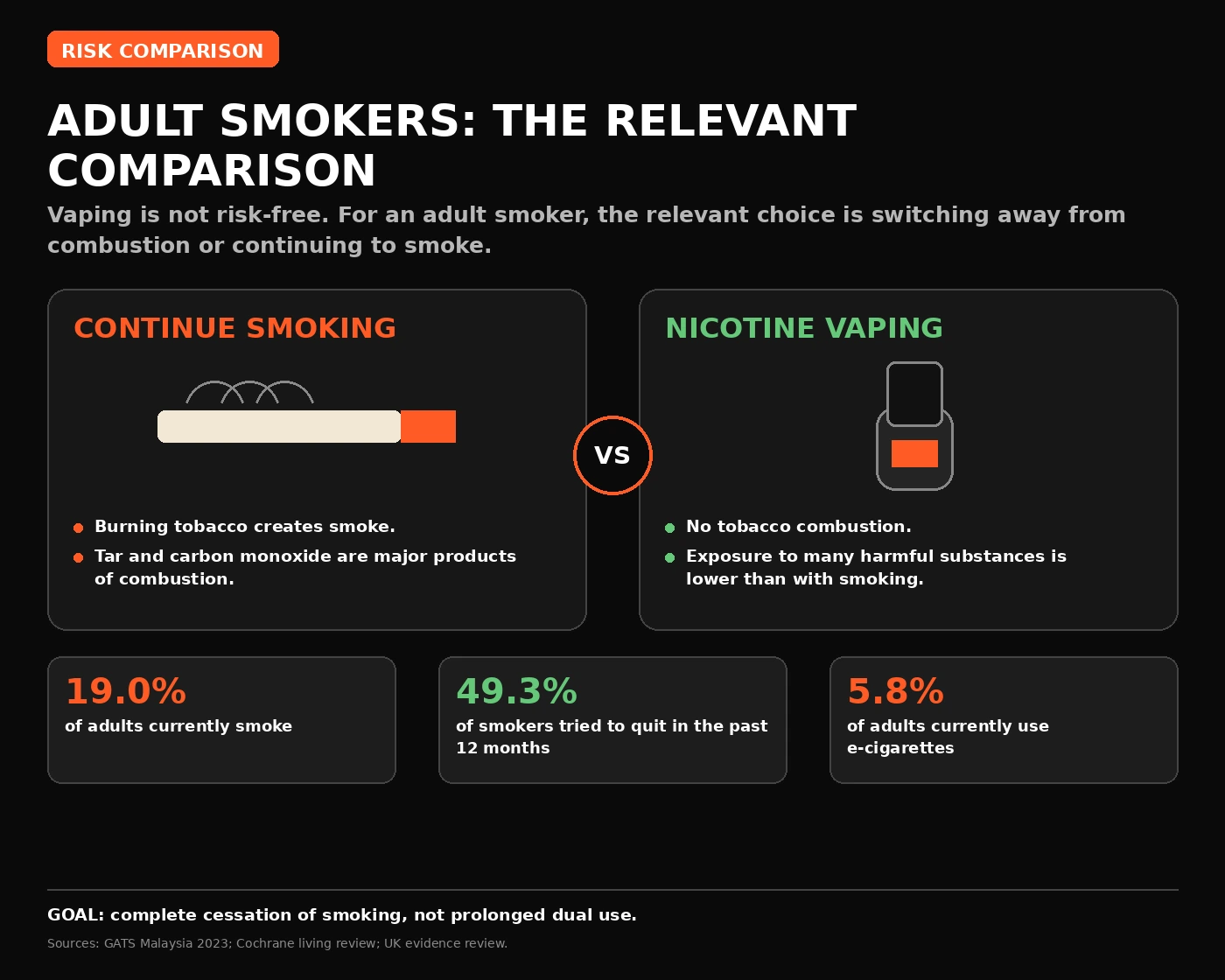
Vaping is not risk-free. But it does not burn tobacco, so its toxicant-exposure profile differs from smoking. The latest Cochrane evidence finds high-certainty evidence that nicotine e-cigarettes increase quit rates compared with conventional nicotine-replacement therapy. 1
This is not a small population that can simply be ignored. Malaysia still has a substantial smoking problem and many smokers are trying to quit. Vape policy should therefore be judged partly by whether smokers leave cigarettes completely, remain dual users or return to smoking.
Before switching from cigarettes, I visited government clinics approximately once every two or three months because of recurring sore throats. During nearly 20 years of vaping, I estimate that I sought treatment for the same problem no more than ten times.
That experience is not a clinical trial and should never be presented as one. But it explains why this issue is deeply personal to many former smokers: they do not see vaping as a fashion. They see it as the thing that helped them stop burning tobacco.
If KKM Wants Smokers to Quit, Give Them a Clear Pathway
Harm-reduction evidence does not mean retailers should make medical claims. But KKM's own 2026 nicotine-dependence management protocol has expanded its scope to include electronic cigarettes or vapes and heated tobacco products. 17
Instead of leaving smokers to search social media for answers, KKM should publish a clear clinician-led pathway: available cessation options, when alternatives may be considered, the goal of complete cigarette cessation, monitoring of dual use and prevention of relapse to smoking.
That would separate official clinical guidance from commercial promotion while recognising that not every smoker succeeds with the same method.
RM369 Million Is a Big Number. Its Methodology Should Be Public.
KKM has cited an annual treatment cost that could reach approximately RM369 million by 2030 for illnesses associated with vaping. Earlier parliamentary material described this as treatment costs that could reach that amount annually by 2030 if firm action were not taken. It is a projection, not necessarily an audited amount already spent by government hospitals today. 2
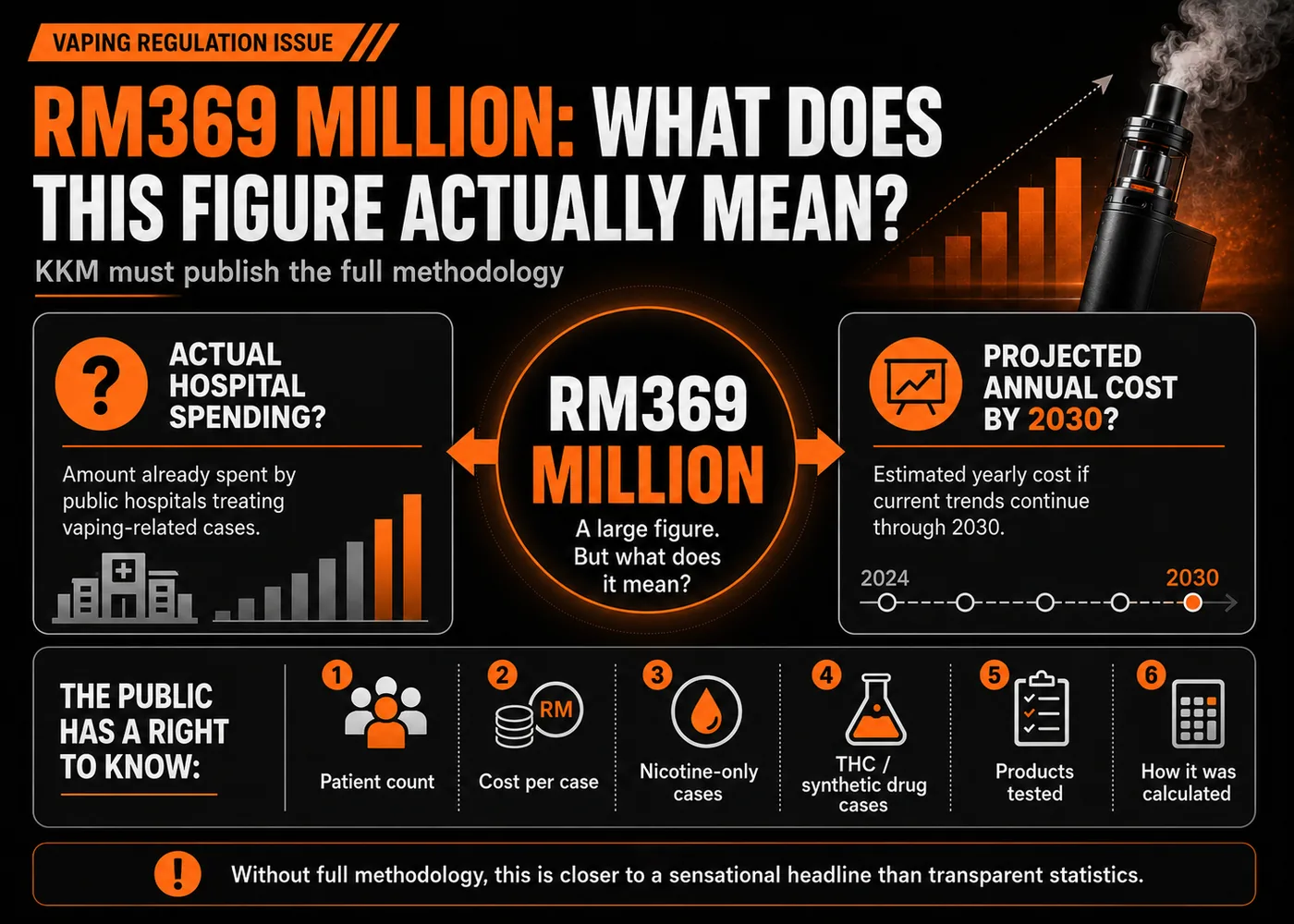
I am not asking KKM to discard the figure. I am asking KKM to show how it was built.
Publish: patient counts, diagnoses, cost per case, modelling assumptions, substance categories, toxicology results, product sources and how many actual products were recovered and tested.
How many cases involved nicotine liquid only? How many involved THC, synthetic drugs, ketamine, mushroom extracts or unidentified substances? How many came from lawful channels and how many from informal sources?
If RM369 million is important enough to support national policy, the methodology is important enough to be open to independent scrutiny.
EVALI Describes an Injury. It Does Not Identify the Chemical Cause.
EVALI is a label for lung injury associated with recent use of a vaping device. The label does not tell us what was inside the cartridge.
A device may contain nicotine liquid, THC, synthetic cannabinoids, vitamin E acetate, ketamine, methamphetamine or an unidentified mixture. Those substances do not become chemically equivalent merely because they were inhaled through similar hardware.
KKM's own quick reference notes that CDC case definitions were created for surveillance and that testing often helps exclude other diagnoses rather than conclusively identify the chemical cause. 3
So when a case is used to justify restrictions on commercial nicotine e-liquid, the substance inside that device should be identified first.
The US EVALI Investigation Shows Why Product Contents Matter
The CDC reported that 82% of hospitalised EVALI patients with substance-use data reported using THC-containing products. It also said vitamin E acetate was strongly linked to the outbreak and warned particularly about THC products from informal sources. 4
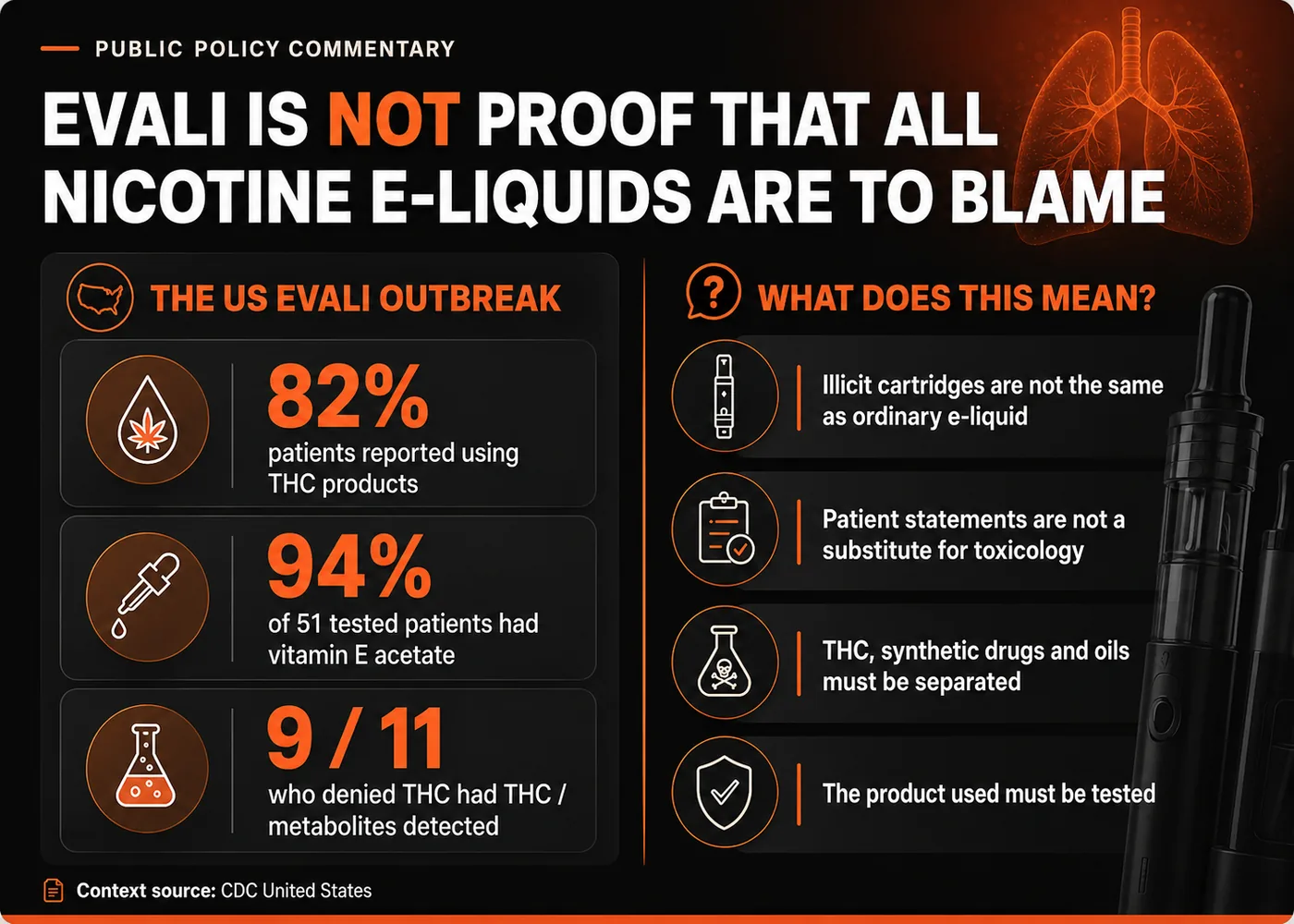
The CDC did not claim every case was completely explained by vitamin E acetate, and that qualification matters. But those findings also cannot be erased when EVALI is used as an argument against the entire nicotine-vaping market.
“I Vaped” Is Not a Toxicology Result
Some EVALI patients reported that they had not used THC. CDC investigation later detected THC or THC metabolites in lung samples from nine of eleven such patients. CDC also discussed recall problems, social-desirability bias and the possibility that patients did not know what their cartridges contained. 6
In Malaysia, the incentive not to disclose drug use may be even stronger because a patient may fear legal consequences, family consequences or stigma.
This does not prove that every patient concealed drug use. It is, however, a powerful reason for KKM not to treat patient self-report alone as proof that ordinary nicotine liquid caused the injury.
Reporting should separate confirmed nicotine cases, confirmed THC cases, synthetic-drug cases, oil-containing products, counterfeit or modified products, unidentified mixtures and cases where the substance was never objectively established.
Drug-Laced Cartridges Are a Drug Problem, Not a Shortcut to Blaming Every Vape
Malaysian authorities have reported seizures of suspected vape products containing synthetic drugs, THC, mushroom extracts and other psychoactive substances. 7 Police have also warned about synthetic cannabis distributed through vape products. 8
Under Malaysian law, delta-9-tetrahydrocannabinol (THC) is listed in the First Schedule to the Dangerous Drugs Act 1952. THC is therefore not a neutral category sitting between “nicotine” and “drugs”. If a cartridge contains THC, it should be discussed and investigated as a drug issue. 23
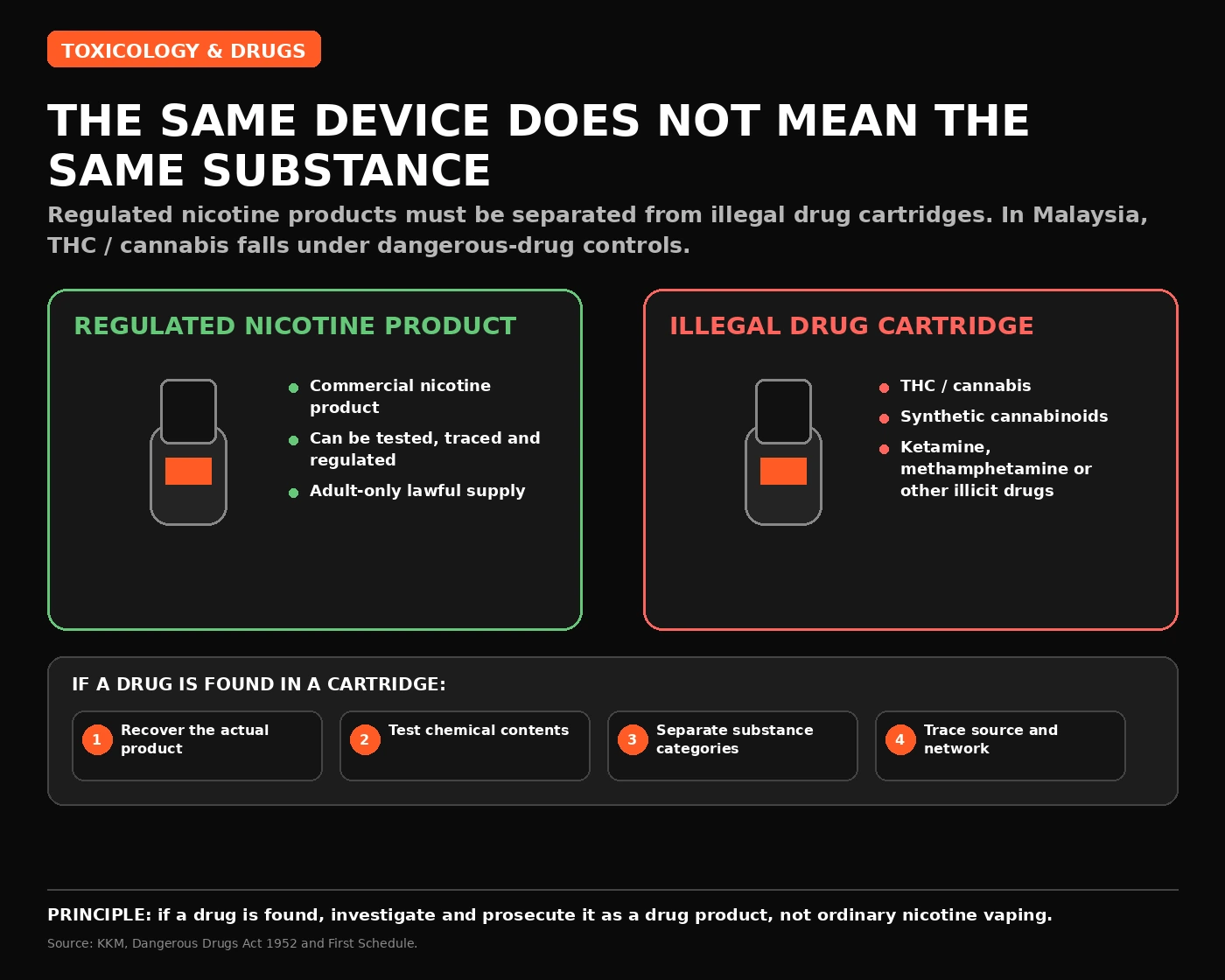
When toxicology confirms an illicit drug, policy language should be precise. That is a drug product using a vape device as its delivery mechanism. Enforcement should target the substance, manufacturers, distributors, financial networks and retailers who knowingly sell it.
A simple principle: if a drug is found in the cartridge, prosecute the drug as a drug. Do not use that crime to represent every nicotine liquid, every adult vaper and every lawful business.
Product Registration Can Become a Financial Wall Around the Lawful Market
KKM requires an official RM5,000 fee for each product type or variant, together with a laboratory analysis report and supporting documents. Its FAQ says the fee is one-off while the smell, flavour, size, form, composition, ingredients, manufacturing process and manufacturing location remain unchanged, and gives a 14-working-day target once complete documents are received. 9
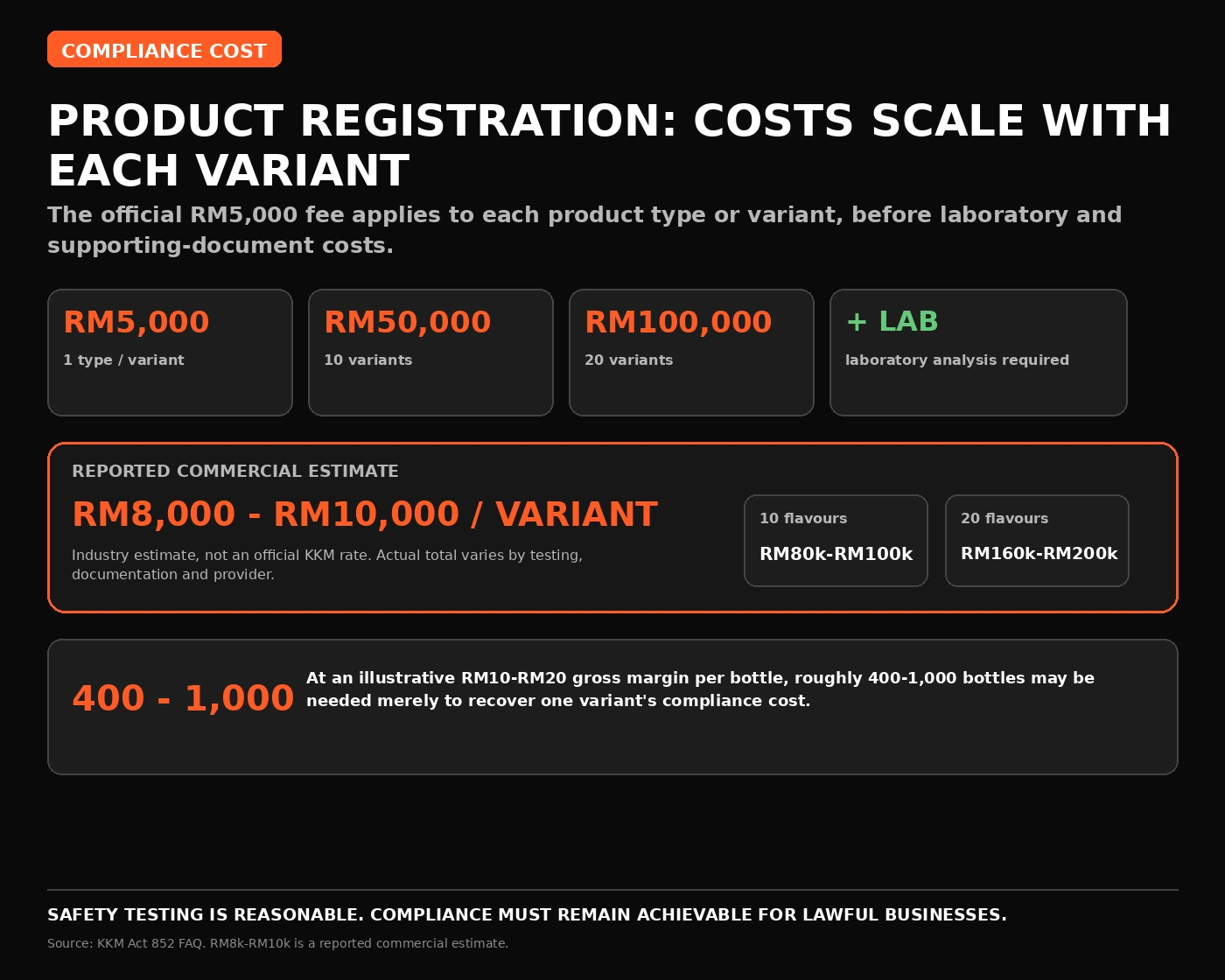
A “one-off” fee can still become enormous when it repeats across variants.
Based on laboratory quotations and compliance experiences reported by affected businesses, the commercial total for one flavour or variant may approach RM8,000 to RM10,000. That is an indicative market estimate, not an official KKM rate.
At an illustrative gross margin of RM10 to RM20 per bottle, an RM8,000-RM10,000 compliance cost for one variant could require roughly 400 to 1,000 bottles simply to recover that variant's compliance expense.
Safety testing is reasonable. Pricing compliant SMEs out of the system is not a safety victory. It can shrink the lawful market while leaving more room for products that are never tested or registered at all.
If the Goal Is to Test Products, Make Compliance Achievable
KKM can keep safety standards high without treating every variation as though compliance has to start from zero.
- Reduce or partly subsidise fees for SMEs.
- Allow scientifically justified grouping of variants that share the same base formulation and manufacturing process.
- Recognise equivalent reports from accredited international laboratories and require local testing where evidence gaps remain.
- Conduct random post-market surveillance and impose severe penalties for fraudulent reports.
- Use part of vape excise revenue to fund independent testing and compliance support.
The United Kingdom, for example, requires ingredient, toxicology and emissions information for relevant products. 10 Malaysia can evaluate evidence that already exists and test strategically rather than repeatedly charging for substantially the same scientific work without a clear safety gain.
The 15 ml Limit: Show the Net Safety Benefit, Not Just the Assumption
Malaysia's packaging rules limit bottled e-liquid to 15 ml, while cartridges and disposable pods are subject to separate limits. 11
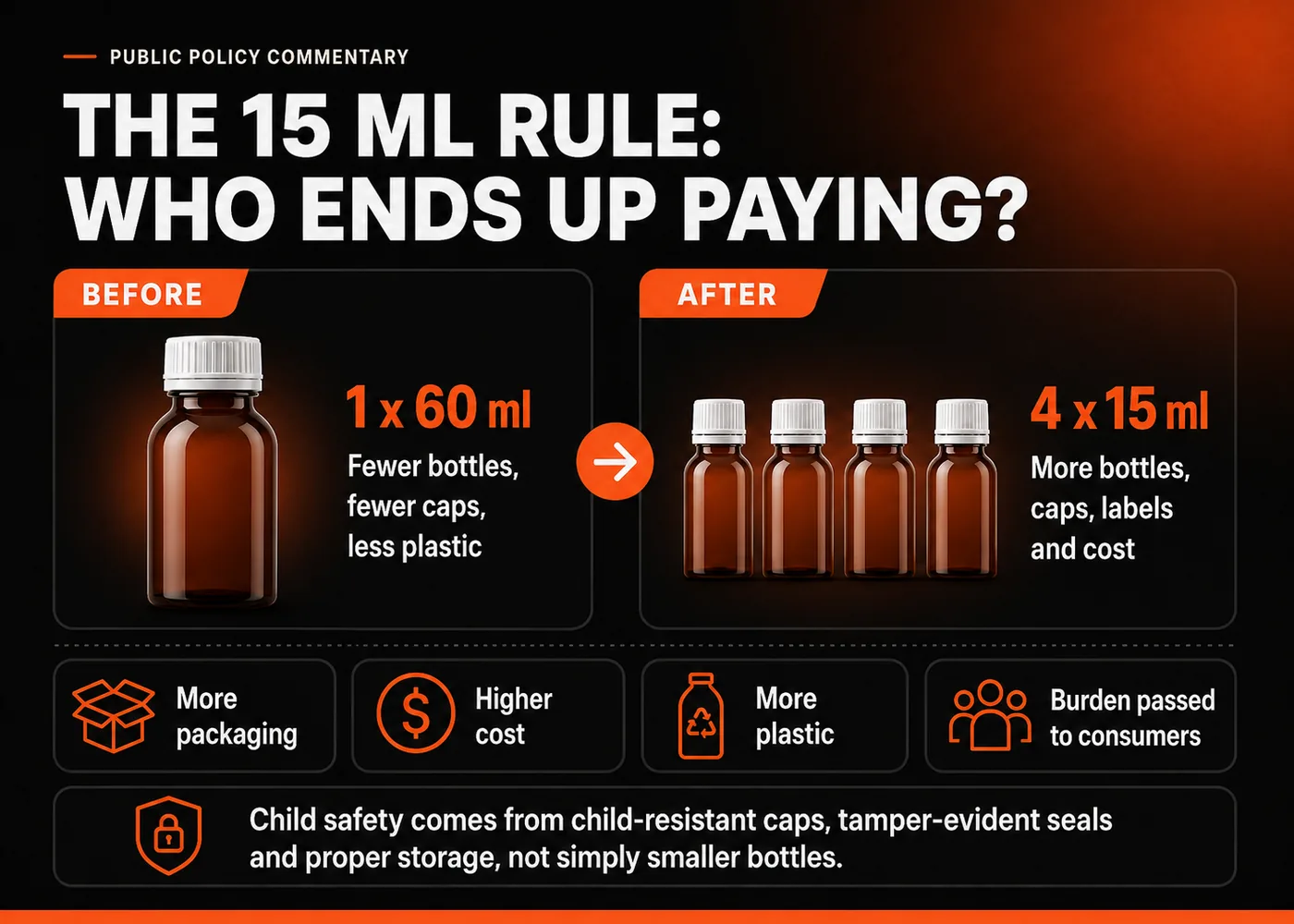
If the rationale is to reduce accidental child exposure, KKM should show why four 15 ml bottles produce a better overall safety outcome than one larger bottle using a certified child-resistant closure, tamper-evident seal and proper warnings.
Container size can affect the quantity available in a single exposure incident. That should be acknowledged. But more containers also mean more handling, waste and chances for one bottle to be misplaced. The rule should be justified by net risk, not the assumption that a smaller bottle automatically means a safer system.
Child Safety Should Focus on Access, Closure and Storage
Child-resistant closures and tamper-evident features are established safety controls for liquid products. Standards such as ISO 8317 provide test methods for reclosable child-resistant packaging. Bottle size and closure performance are separate questions, and both should be assessed with evidence. 12
No closure should be described as completely childproof. Adults still have to close bottles correctly and store them out of reach.
If serious harm occurs because of proven negligence, investigate the negligence and impose proportionate consequences. But do not assume that making every responsible adult buy four containers instead of one automatically makes every home safer.
A Blanket Online-Sales Ban Removes the Channel That Can Be Most Auditable
KKM's Act 852 enforcement FAQ states that smoking products cannot be sold online. 9
The problem with a blanket approach is that a lawful digital transaction can record more than an anonymous cash sale: verified identity, age, address, payment method, product purchased, invoice, courier trail and proof of delivery.
The question should be: why prohibit a transaction that can verify ID and be tracked from payment to delivery, if demand then shifts to Telegram, WhatsApp or sellers with no verifiable identity?
The problem is not e-commerce technology. The problem is selling without age verification, licensing and enforcement.
Replace the Online Ban With Mandatory, Auditable Digital KYC
If the objective is to ensure that only adults can buy, use technology to enforce that objective.
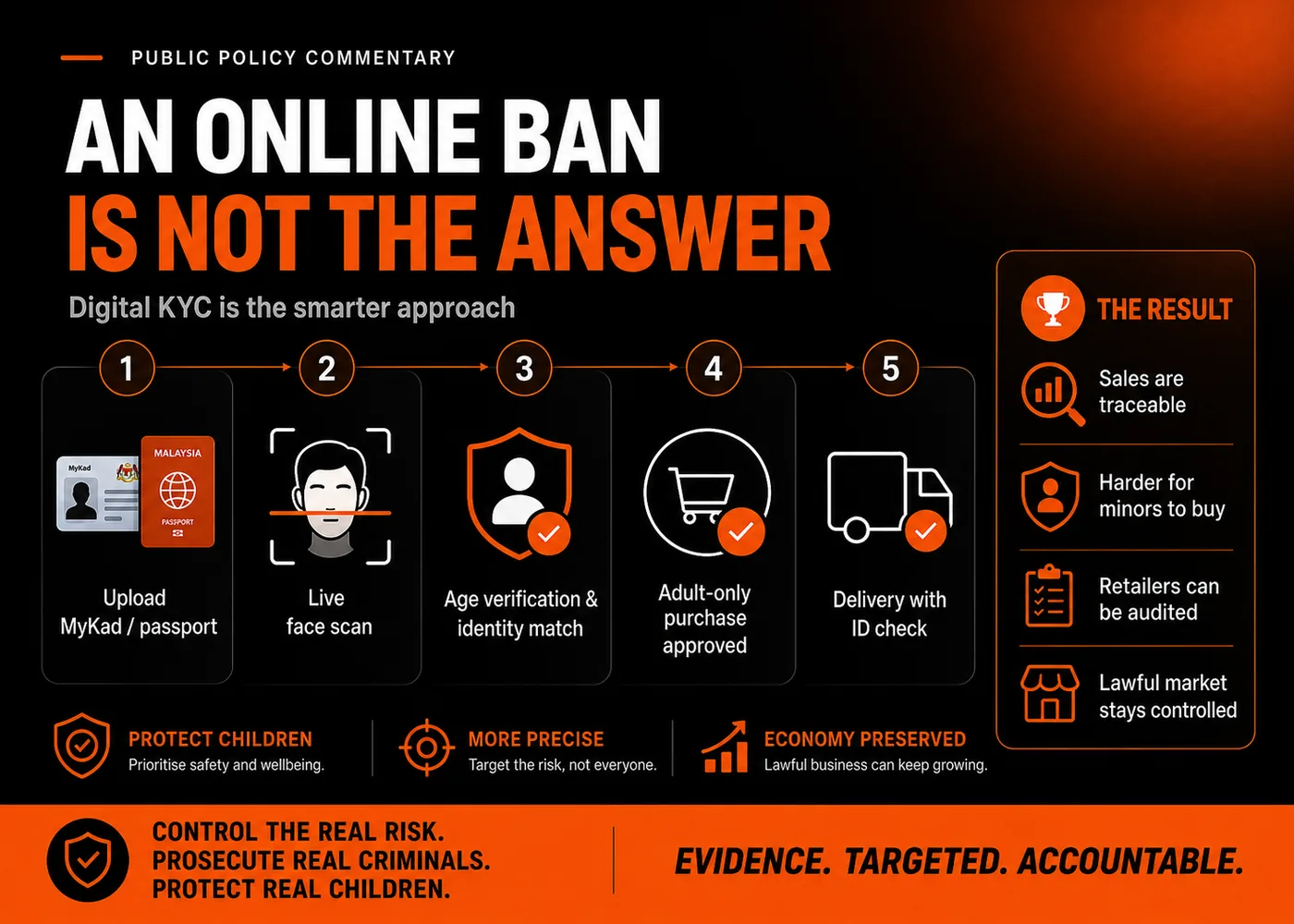
- MyKad, passport or another approved government ID.
- Date-of-birth verification before checkout.
- Live-face matching with liveness detection.
- No guest checkout without verified identity.
- Encrypted audit records.
- Re-verification for suspicious activity.
- Verified adult receipt for delivery.
- Controlled KKM test purchases to test real compliance.
Retailers that deliberately bypass KYC or sell to minors should be suspended and heavily penalised. But retailers willing to pay for verification, redesign checkout, preserve audit records and use adult delivery should have a lawful route to comply.
Local reporting indicates that prohibited online trade can migrate into closed, harder-to-see digital networks. 13 A ban may remove lawful websites without removing sales; it may simply remove the audit trail.
If the Priority Is Children, Focus on the Products They Can Most Easily Buy and Hide
Underage use is a serious problem. NHMS 2022 reported that 14.9% of Malaysian adolescents surveyed were current e-cigarette or vape users, and many started before age 14. 14
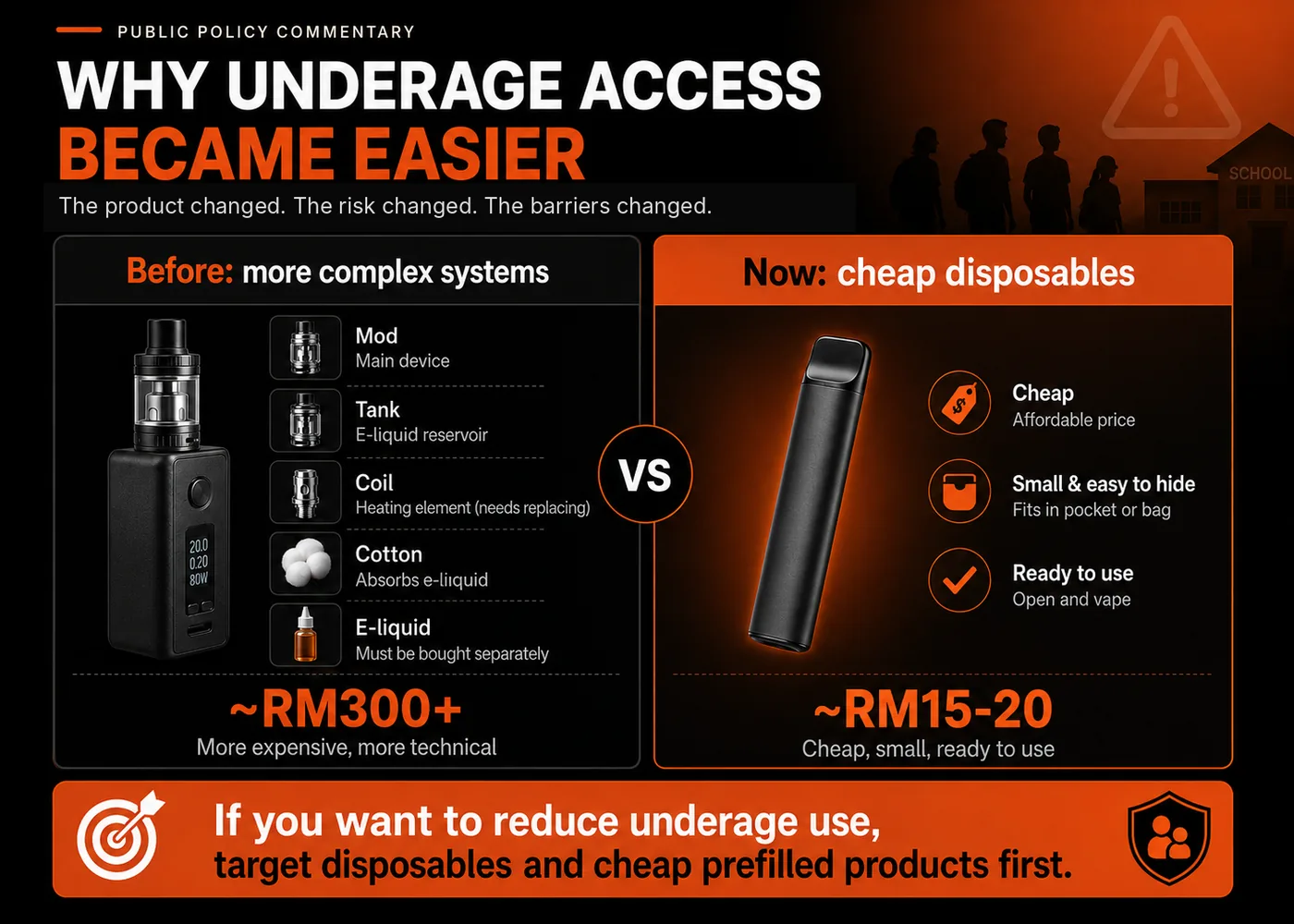
But “vape” is not one uniform product category. Traditional open systems require a device, tank, batteries, coils, cotton, e-liquid, maintenance and basic knowledge. Market examples can put that starting cost at around RM300 or more.
I am not claiming price alone proves the cause of underage use. KKM should publish Malaysian data by device type, purchase source, price and sales channel. But if a category is dramatically cheaper, smaller and immediately usable, it is reasonable to test whether it creates a larger access route.
Do Not Start With Complex Adult Systems if the Access Problem Is Driven by Easier Products
Malaysia should publish local data showing what devices minors actually use. In the United States in 2024, 55.6% of student e-cigarette users most often used disposables, compared with 7% who most often used tank or mod systems. 15
Malaysia has meanwhile indicated proposed phased restrictions beginning with open systems. 16
If the immediate concern is children, KKM should explain why more complex refillable systems used by many long-term adults should be targeted before products that are cheap, small and ready to use.
- Heavily restrict or prohibit cheap disposables if Malaysian data shows they dominate underage use.
- Set defensible nicotine and capacity limits.
- Ban toy-like, gadget-like or clearly child-oriented designs.
- Require batch traceability and battery take-back.
- Keep adult refillable systems in licensed channels with registered liquids and age verification.
Do Not Confuse Flavours With Marketing to Children
KKM should ban cartoons, child-candy branding, toy-like packaging and marketing that is clearly directed at minors. That is targeted marketing control.
But instead of assuming every non-tobacco flavour exists for children, KKM should examine how adult former smokers use flavours and what happens if those options are removed across the board.
Before any broad flavour prohibition, publish an impact assessment covering underage use, complete switching away from cigarettes, relapse to smoking and illicit supply. Regulate child-directed presentation. Do not treat adult taste preferences as proof of child-directed intent.
The Black Market Does Not Disappear When the Legal Market Becomes Impractical
When lawful products become too expensive to register, restricted to impractical sizes, prohibited through traceable sales channels or simply unavailable, demand does not disappear with the regulation.
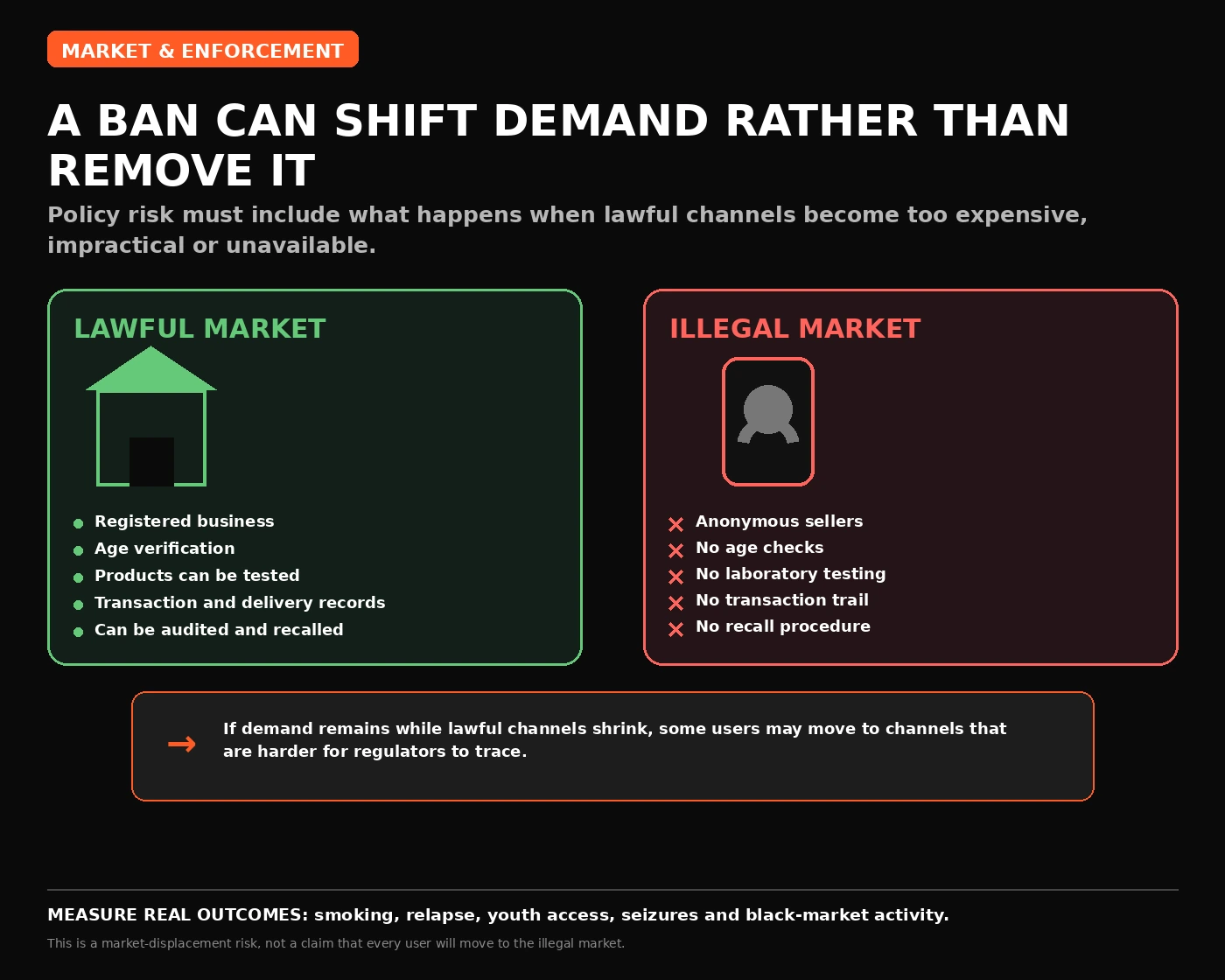
Some users may return to cigarettes. Others will move to private groups, counterfeit products, anonymous liquids or sellers with no reason to follow nicotine limits, packaging rules, minimum-age requirements, laboratory testing or recall procedures.
A lawful market can be tested, licensed, audited, recalled and punished. An illegal market gives KKM none of those tools.
Regulation therefore has to be strict enough to control the market but realistic enough to keep adult demand inside channels that can actually be seen and enforced.
Do Not Measure “Success” by How Many Lawful Shops Disappear
A decline in lawful vape sales or the closure of premises does not by itself prove that public health improved.
KKM should publish baselines and targets for adult smoking, complete switching away from cigarettes, complete nicotine abstinence, dual use, relapse to smoking, youth use by device category, illicit-product seizures and hospital toxicology findings.
GATS 2023 found that 19.0% of adults still smoked and 49.3% of adult smokers had made a quit attempt in the previous 12 months. 20 If vape policy reduces legal sales while more smokers return to cigarettes or unknown products, that is not an outcome to celebrate.
Before major restrictions, publish an impact assessment. After 12 or 24 months, publish the actual outcomes and revise the policy if it is not achieving its stated purpose.
Safety Also Requires Privacy, Product Recalls, Valid Evidence and Waste Controls
KYC data protection
- Collect only the data genuinely required.
- Encrypt identity and biometric information.
- Prohibit reuse of verification data for marketing.
- Set clear retention and deletion periods.
- Require access controls, vendor audits and appropriate data-breach reporting. 18
Product traceability and recalls
- Require verifiable batch numbers, QR codes or serial numbers.
- Create a public product-registration database.
- Mandate adverse-event reporting and rapid batch recalls.
- Provide a clear consumer-complaint channel.
Hospital and enforcement evidence
- Use documented chain-of-custody procedures.
- Test samples in accredited laboratories for nicotine, THC, synthetic cannabinoids, oils and adulterants.
- Publish anonymised aggregate findings and preserve samples for independent retesting where appropriate.
Batteries, electronic waste and fire risk
- Treat disposable vapes as electrical products requiring specialist disposal.
- Require retailer take-back systems and battery recycling.
- Include fire risk and chemical leakage in regulatory impact assessments. 19
A More Rational Malaysian Vape Policy
KKM does not have to choose between “unregulated freedom” and “ban it”. There is a stronger third option: a strict adult market that is traceable and expensive to violate, but still practical to comply with.
Children
- Prohibit all sales to minors and run controlled purchase operations.
- Require ID in stores, digital KYC online and verified adult delivery.
- Suspend licences and impose serious penalties for deliberate sales to minors.
- Provide nicotine-cessation help for young people who are already dependent.
Adult smokers and former smokers
- Publish an official clinical pathway for smoking cessation and harm reduction.
- Prioritise complete switching away from cigarettes rather than prolonged dual use.
- Do not make adult users the enforcement target when the real problem is illegal supply or non-compliant sellers.
Products and access
- Target cheap disposables and categories shown by evidence to dominate underage use.
- Keep refillable adult systems available through licensed retailers.
- Permit online sales with mandatory KYC, audit trails and adult delivery.
- Control marketing to children without treating every adult flavour as child marketing.
Registration and safety
- Reduce cumulative fee burdens for SMEs and recognise equivalent accredited foreign testing.
- Require batch numbers, ingredient reporting, recalls and a public registration database.
- Reassess the 15 ml limit using net-risk analysis.
- Use part of excise revenue for independent testing, enforcement, youth prevention and compliance support.
Drugs, hospitals and transparency
- Classify drug cartridges as drug products when substances are confirmed.
- Test and publish detected substances, toxicology categories and product sources.
- Use documented chain of custody and preserve samples for appropriate retesting.
- Publish methodology, regulatory-impact assessments and reasons for accepting or rejecting major policy proposals.
Implementation
- Provide a reasonable transition period for businesses trying to comply.
- Publish technical standards, recognised laboratories, processing times and appeal procedures.
- Review actual policy outcomes openly after 12 or 24 months.
KKM Can Protect Children Without Punishing Every Adult
I am not asking KKM to stop regulating vaping. I am asking KKM to regulate it more precisely.
If a product contains drugs, prosecute the drug offence. If a retailer sells to children, punish that retailer. If a product fails testing, recall it. If a business falsifies reports, close it and prosecute where appropriate.
But do not use drug cartridges to condemn every nicotine liquid. Do not make repeated fees reaching tens or hundreds of thousands of ringgit the price of being “lawful”, then be surprised when illicit supply grows. Do not force four 15 ml bottles without showing that the overall safety outcome is actually better. Do not shut down an e-commerce channel that can be identity-verified and audited if the alternative is anonymous sellers.
And most importantly, do not forget that behind these rules are real smokers who stopped smoking, their families, employees, SMEs and adults who want to comply with the law.
KKM can still reconsider rules that were drawn too broadly and correct them before damage to the lawful market becomes harder to reverse. Changing policy when the evidence points to a better path is not weakness. That is exactly what evidence-based public health should do.
Respectfully,
A Malaysian former smoker and long-term vaper
Contact KKM Through Channels That Create a Record
If you agree that children should be protected without punishing every adult user, state your view through KKM’s official channels. Keep it short, specific and respectful. For a formal enquiry or complaint, ask for a reference number and a written response.
Act 852 & Product Registration
For enquiries on Act 852 implementation, registration and product regulation.
Official KKM source ↗Office of the Health Minister
Official ministerial office channels for policy feedback and requests for a response.
Official KKM directory ↗Formal KKM Record
Use SISPAA if you want your feedback or complaint recorded through the government’s formal system.
Official KKM portal ↗One personalised, clear message that can be answered is more useful than repeated automated messages. State your own experience or concern and keep it professional.
Sources and Further Reading
- Cochrane Review: Electronic cigarettes for smoking cessation
- Parliament of Malaysia material concerning projected vaping-related costs
- Ministry of Health Malaysia: Quick Reference on EVALI Management
- CDC: EVALI outbreak update and THC product findings
- CDC: Vitamin E acetate in bronchoalveolar lavage fluid
- CDC: Laboratory findings and under-reporting limitations
- Bernama: Seizures of suspected drug-laced vape products
- Royal Malaysia Police: Synthetic drugs distributed through vape products
- KKM: Act 852 implementation and enforcement FAQ
- United Kingdom guidance on electronic-cigarette emissions data
- Malaysia packaging and labelling regulations
- ISO 8317: Child-resistant reclosable packaging, requirements and testing procedures
- The Vibes: Online vape trade moving into less visible networks
- Institute for Public Health: NHMS 2022 adolescent health survey
- CDC: Youth e-cigarette product use in 2024
- Bernama: Malaysia's proposed phased restrictions beginning with open systems
- KKM: Nicotine Dependence Management Pharmacy Service Protocol, Third Edition 2026
- Personal Data Protection Commissioner: guidance on data-protection officers and data-breach notification
- GOV.UK: vapes as electrical items, fire risk and take-back responsibilities
- GATS Malaysia 2011 & 2023 comparison fact sheet on tobacco and e-cigarette use
- KKM: Official Health Minister Office directory and ministry contact details
- Free Malaysia Today: Government withdraws appeal against liquid nicotine exemption ruling, 18 August 2026
- KKM Pharmaceutical Services Programme: Dangerous Drugs Act 1952 and First Schedule